






What Happens When You Stop Designing Weddings Around MOQ
New Delhi [India], October 22: Print Zombies is taking its no-MOQ digital printing approach beyond fashion, helping wedding designers and planners create personalised textile designs for mandaps, stages and event spaces. By producing exactly the fabric quantity required, the company aims to give designers greater creative freedom without minimum-order constraints. The Problem That Started With [...]

New Delhi [India], October 22: Print Zombies is taking its no-MOQ digital printing approach beyond fashion, helping wedding designers and planners create personalised textile designs for mandaps, stages and event spaces. By producing exactly the fabric quantity required, the company aims to give designers greater creative freedom without minimum-order constraints.
The Problem That Started With Fabric
We started Print Zombies because, after years of working with and as designers across be-spoke and E-com fashion industry, we had seen how often a creative decision was dictated by a textile supplier’s production requirement rather than by the designer’s actual vision. A designer would have an idea that needed twenty, thirty, or perhaps fifty metres of a particular fabric—but the conversation quickly became about minimum quantities, leftover deadstock, and whether the design could justify an industrial production run. At some point, the designer stopped designing for the idea and started designing around the supplier.
That was the problem Print Zombies was built to solve.
Our belief from the beginning has been simple: creativity flows better when MOQ is not a concern. If a designer needs only what the design requires, we should be able to help them produce exactly that. We built our processes, our fabric library, and our digital printing capability around that principle. Over the years, we have seen what that freedom means for fashion designers: it allows them to experiment, build without dead inventory, and make decisions based purely on design.
What We Started Seeing Beyond Fashion
Over the last eight months, I have been thinking about whether that exact same problem exists outside garments.
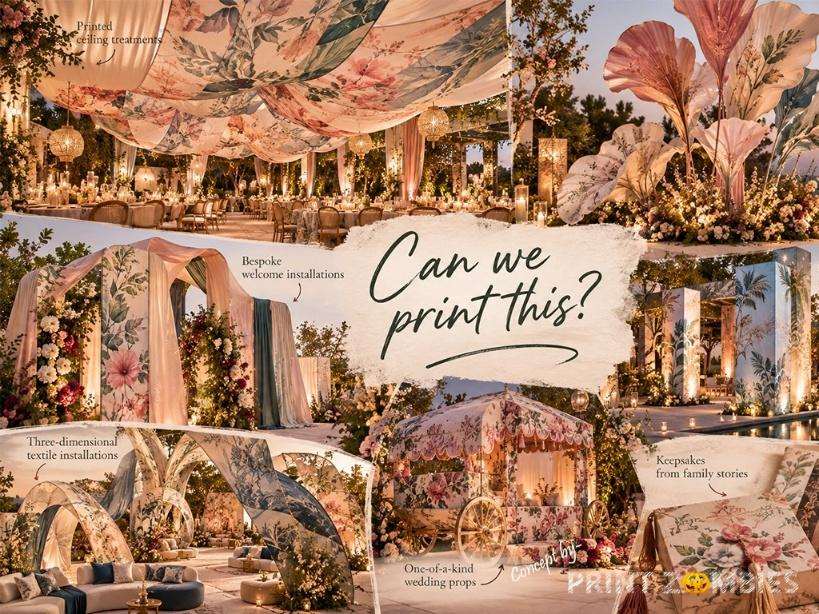
Not as a theoretical exercise, but by looking at what was already emerging through our clients, conversations with wedding planners, and small experiments with people who already trusted our work. I kept coming back to the same observation: weddings are becoming increasingly personalised, but that personalisation is still largely concentrated in what people wear.
The moment you move from the garment into the physical environment around it, creative freedom drops considerably.
A wedding can feature an exquisite bespoke lehenga, personalised stationery, carefully considered invitations, and an enormous amount of thought invested in the family’s visual identity. Yet the mandap, Varmala stage, and lounge seating are frequently treated as a separate category altogether.
There are practical reasons for this. Wedding production involves tight turnarounds, structural limitations, and materials traditionally chosen purely for availability. Wedding decorators aren’t doing something wrong—they are simply solving a different operational challenge. But from the perspective of someone who has spent years working with fabric and print, there was clearly an unaddressed gap.
The interesting problem was never about printing a few event banners. That wouldn’t interest us. The real problem is what happens when a designer wants to create a textile environment genuinely built for that specific wedding—where the requirement is small, but technically complex.
40 Metres of Fabric Can Be a Very Complicated Design Problem
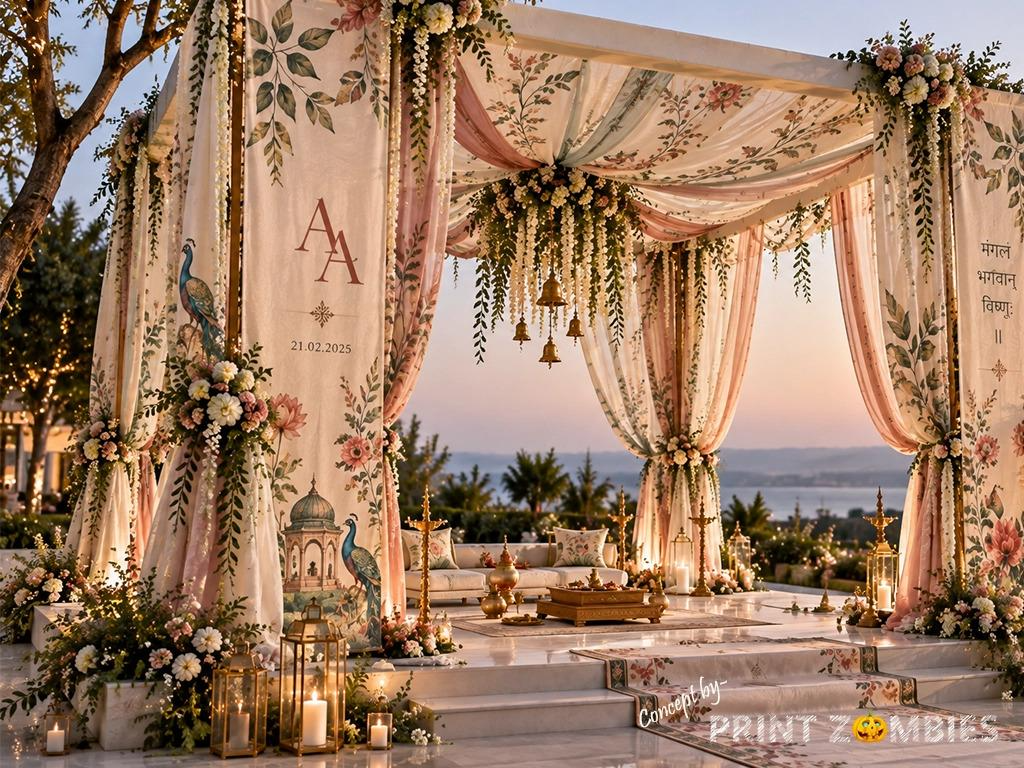
Take a mandap or a Varmala stage. In many cases, the total fabric requirement is somewhere around 40 to 60 metres.
From a conventional textile production perspective, that is not a large enough order.. But quantity tells you nothing about complexity. Those 50 metres may eventually become several separate panels: a canopy, backdrop drops, chair wraps, cushions, or an aisle runner. They are physically separate pieces, yet once installed, they are expected to look like one coherent visual composition.
That is where our background becomes directly relevant.
The challenge is not simply printing ink across 50 metres of cloth. The challenge is engineering how that artwork divides:
- Where each panel begins and ends
- How motifs flow across structural seams
- How scale shifts across a three-dimensional frame
- How the entire composition behaves once brought together on-site
A design that looks seamless on a desktop monitor can fail completely once split across physical drops. We have spent years solving variations of this exact problem in fashion, engineering artwork around pattern pieces, seams, and grain lines. Wedding textiles present a different application of the exact same discipline.
We Are Not Installing the Wedding. We Are Solving the Textile Problem.
I want to be explicit about what Print Zombies is—and what it is not—in this vertical.
We are not becoming a wedding decoration or installation company. We will not install the mandap, rig the trussing, or manage production at the venue. Planners and their production teams already possess that expertise.
Our role sits immediately before that step. We work with the designer on the textile itself: understanding the spatial concept, selecting the correct fabric base, engineering the artwork across individual panels, and producing the exact meterage the design requires.
The value we want to create is not about taking control away from the planner. It is the opposite: We want to give the planner far greater creative control over what they can create with fabric, without having to compromise their aesthetic for a supplier.
When MOQ Dictates the Designer’s Pen
This is where our original No MOQ philosophy becomes meaningful in a new context.
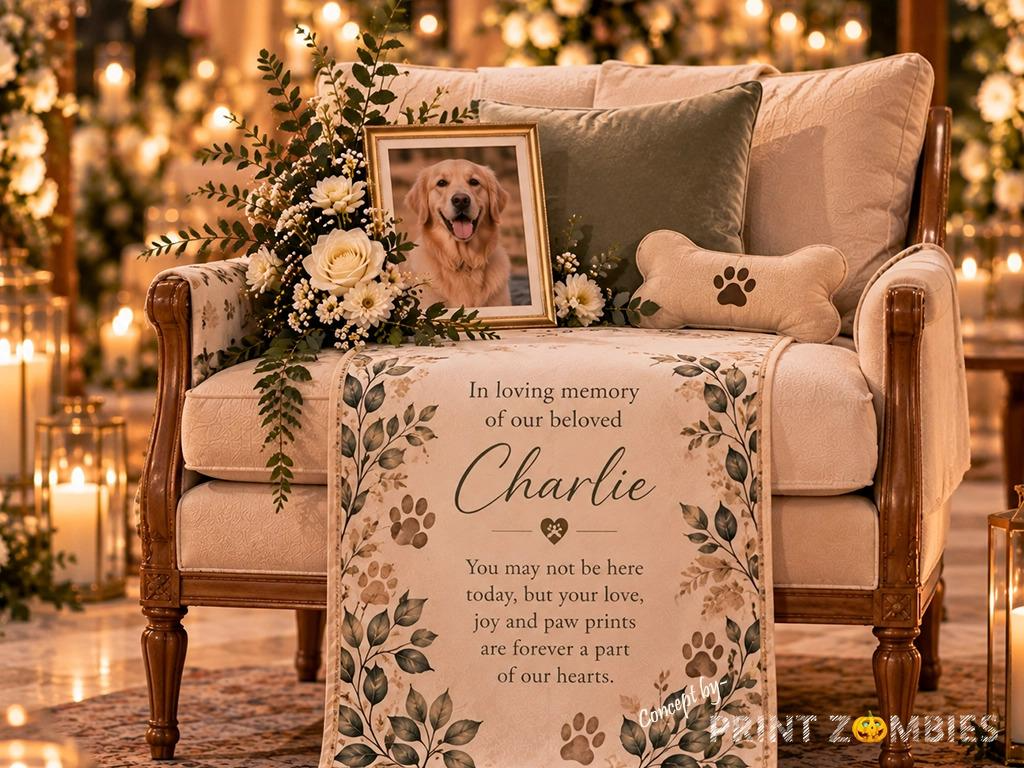
A wedding does not need the same textile treatment across every function. In fact, it rarely should. A Mehendi has its own energy, a Sangeet demands a different drama, and the pheras carry their own sacred, quiet mood.
When a textile supplier demands a massive minimum run for custom prints, the planner is forced to think commercially before they can think creatively. They find themselves having to convince a family to repeat a backdrop motif across multiple functions, or abandon an intimate idea simply because 35 metres doesn’t justify a print run.
We built Print Zombies to remove that compromise from fashion; accepting it in weddings felt contradictory. If a Mehendi lounge needs 35 metres, we print 35 metres. If the mandap the next evening requires 55 metres of an entirely different engineered design, that should be just as feasible.
The installation should dictate the quantity. Not the supplier.
Why We Took Eight Months to Get Here
I was deliberately cautious about launching this. It would have been easy to put up a webpage with pretty wedding renders and announce a new decor vertical overnight. But that isn’t how we operate.
We needed to know that our capabilities actually solved a real problem for spatial designers:
- Could the panel engineering hold up under real venue conditions?
- Were our fabric bases performing properly under variable venue lighting?
- Could production timelines align with the chaotic realities of wedding timelines?
- Did planners actually find real creative leverage in this service?
We spent eight months testing ideas, executing private trials with existing clients, and learning what worked and what didn’t. Ideas that seemed clever in theory were discarded when they proved impractical on-site. What remained was a clean, reliable proposition.
What We Actually Bring to the Design Table
We are offering designers another material and a higher degree of creative freedom.
A planner can bring us finished artwork, a rough sketch, an ancestral motif, a detail borrowed from the couple’s attire, or simply an idea they haven’t figured out how to translate into fabric yet. Our responsibility is to work through the textile science and execution behind it.
We already have the design team. We already understand fabric behavior, dye reaction, scale, and short-batch digital production. We already know that a small order often demands far more technical thought than an industrial run.
Wedding decor is simply a different canvas for the exact same capability.
The Same Print Zombies Philosophy, a Different Canvas
The opportunity here is not to add more decoration to weddings. There is already plenty of decor. The opportunity is to make the textile elements more considered, more personal, and uncompromised by supply-chain limitations.
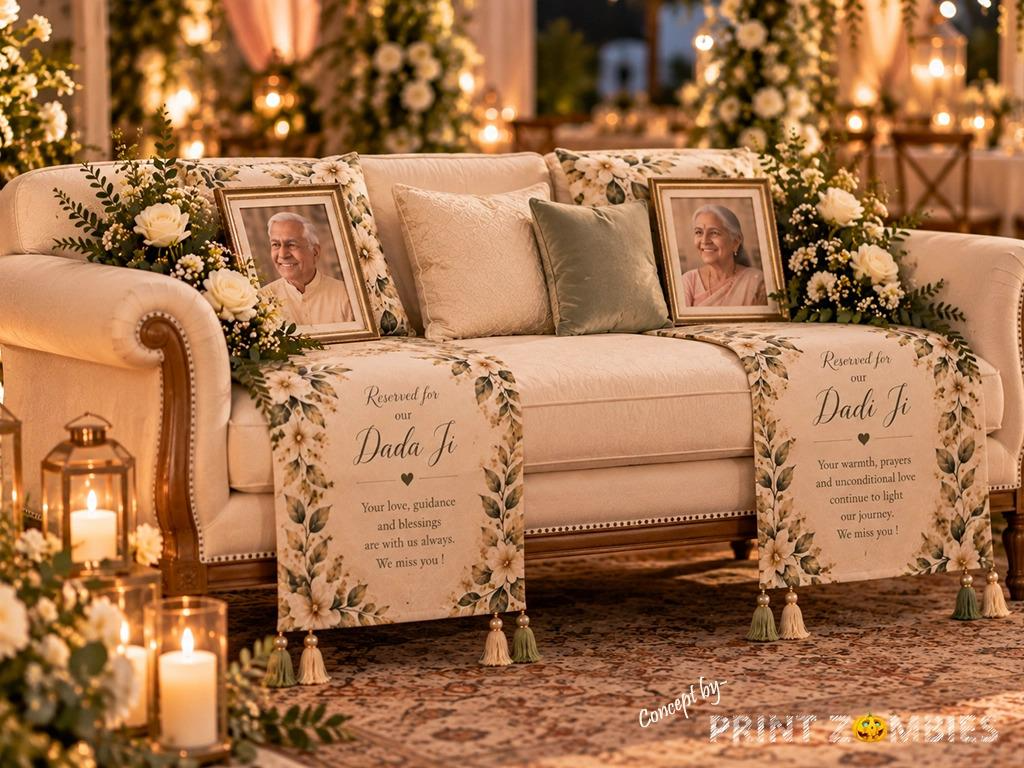
If a wedding is designed around a specific story, the fabric should reflect that story. If three functions need three distinct visual identities, no vendor should force them to look alike. And if an entire stage needs only 45 metres of fabric, that idea deserves to be made.
We started Print Zombies by asking fashion designers what they wanted to create, and then solving the textile problem to make it happen. We are doing the exact same thing for wedding designers and planners.
You bring the space, the concept, the measurements, and the story. We bring the textile engineering, fabric selection, the printing precision, and the freedom to produce only what the idea requires.
If you object to the content of this press release, please notify us at pr.error.rectification@gmail.com. We will respond and rectify the situation within 24 hours.