

.jpg)



Nikhil Kamath Tells Brian Armstrong That Crypto Became the Thing It Was Built to Escape on the Latest Episode of People by WTF
Nikhil Kamath opens the latest episode by disqualifying himself, and it turns out to be the most useful thing he does. He has never bought any crypto, not once, and says he expects to leave the conversation exactly as he entered it. Then he asks Brian Armstrong, co-founder and CEO of Coinbase, to stop being a founder for two hours and become a college professor. Armstrong obliges. What Kamath does with the lesson becomes the story. Brian Armstrong in podcast chat with Nikhil Kamath His central provocation arrives without warning and Armstrong never quite resolves it. Bitcoin began as a protest, Kamath argues: against governments printing without consent, against intermediaries, against permission itself. Look at it now. Stablecoins backed by US Treasuries. KYC at every turn. Regulatory clarity negotiated in Washington. Five years ago crypto meant something democratic and open. Today, he says, the first image that comes to mind is Donald Trump. Somewhere along the way the movement became the establishment. He says to Armstrong: it is strange to watch an engineer become a lobbyist. Armstrong doesn't accept the premise, crypto is inherently apolitical, he argues, and his hope is a framework that outlasts whoever holds office. Kamath lets the disagreement stand. Armstrong's provocation runs the other way, and it is the one India will hear. Asked what a 25-year-old could build under the country's crypto tax regime, he offers no product idea and no workaround. He calls it one of the most punitive regimes anywhere Coinbase operates: the barrier is policy, not technology, and no entrepreneur solves a tax rate with a better product. His advice is political, Indian crypto users need to make themselves visible, because governments rarely respond to constituencies they cannot see. Between those positions sits the argument that matters. Armstrong wants India to issue a digital rupee in stablecoin form with legislation behind it: dollar stablecoins succeed precisely where local digital fiat leaves a vacuum, and a country that built UPI might as well finish the job. Kamath's answer is about sovereignty, made as a sceptic rather than a nationalist. A government running a tight fiscal system has little incentive to open an off-ramp into a dollar-backed instrument it neither issues nor controls. Look at what happened when the United States cut Russia out of SWIFT, he says, and ask why India would hand anyone that lever. They agree on remittances, roughly USD 150 billion a year by his reckoning, the largest flow in the world, still slow and still expensive. They agree on almost nothing else. Kamath is sharpest when he stops arguing ideology and starts auditing arithmetic. If USDC is backed by short-term Treasuries yielding four percent, and Treasuries yield once, where does the second yield come from? If most of it flows back to customers, where is Coinbase's spread? Is ten percent of four percent enough for the risk? Armstrong answers directly, ninety percent to the user, ten retained, balance-sheet risk with the issuer rather than the exchange. The questions matter more than the answers. It is a brokerage founder asking a crypto CEO to show his workings, and it earns him the provocations on either side of it. On AI, it becomes clear Kamath has been making one argument all along. Armstrong worries AI concentrates wealth inside a few companies. Kamath worries it concentrates value inside another country, the harder problem, because it stops being about inequality and becomes about whether India is in the value chain at all. He remembers Microsoft and Linux: two things almost the same, and the years of being charged nothing that made it impossible to leave once the charging began. The last thing India needs, he says, is a generation of builders paying twenty dollars a month to an American company for the model their business runs on, held hostage the day the open-source alternative catches up. Armstrong broadly agrees, the open models run six months behind at a fraction of the inference cost, most workloads will end up there, and the valuations he is watching make him nervous. What stays after the episode is how both men learned to deal with power. Armstrong assumed, as a young engineer, that following the law meant never having to think about government. It didn't. He went to Washington anyway and could not tell for years whether it worked, until Coinbase sued its own regulator, against nearly everyone's advice, and won. His rule: don't do it unless the issue is existential and you are certain you are right. This was both, because capitulating would probably have ended the crypto industry in the United States. He talks about the USD 150,000 cheque from Paul Graham that gave him permission to quit his job. Kamath answers with Foundry, twenty-odd founders, half a million dollars each, a house to bu

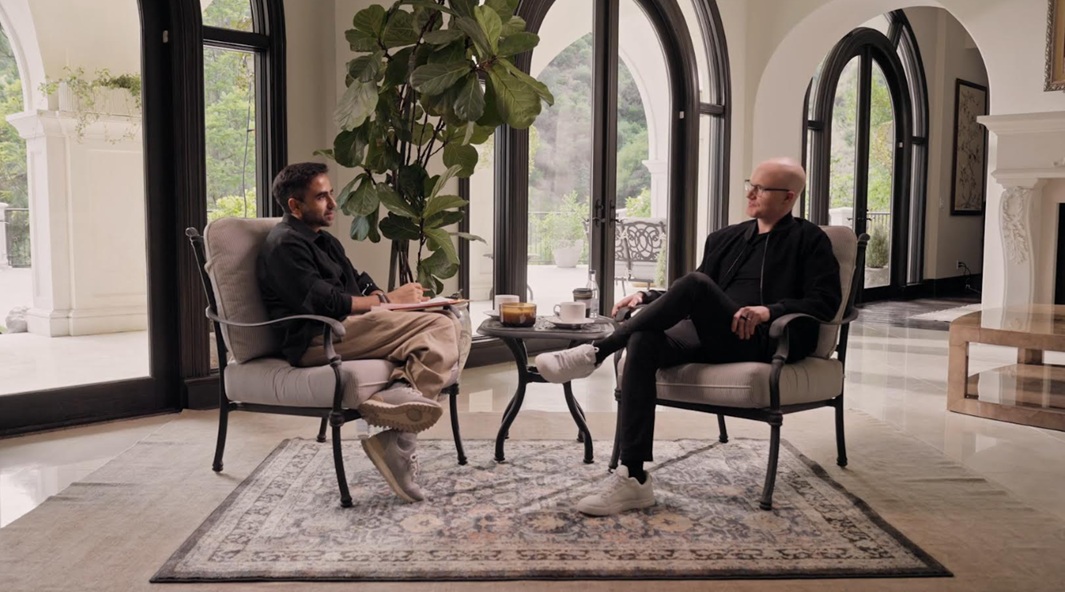
Nikhil Kamath opens the latest episode by disqualifying himself, and it turns out to be the most useful thing he does. He has never bought any crypto, not once, and says he expects to leave the conversation exactly as he entered it. Then he asks Brian Armstrong, co-founder and CEO of Coinbase, to stop being a founder for two hours and become a college professor. Armstrong obliges. What Kamath does with the lesson becomes the story.
|
|
Brian Armstrong in podcast chat with Nikhil Kamath
His central provocation arrives without warning and Armstrong never quite resolves it. Bitcoin began as a protest, Kamath argues: against governments printing without consent, against intermediaries, against permission itself. Look at it now. Stablecoins backed by US Treasuries. KYC at every turn. Regulatory clarity negotiated in Washington. Five years ago crypto meant something democratic and open. Today, he says, the first image that comes to mind is Donald Trump. Somewhere along the way the movement became the establishment. He says to Armstrong: it is strange to watch an engineer become a lobbyist. Armstrong doesn't accept the premise, crypto is inherently apolitical, he argues, and his hope is a framework that outlasts whoever holds office. Kamath lets the disagreement stand.
Armstrong's provocation runs the other way, and it is the one India will hear. Asked what a 25-year-old could build under the country's crypto tax regime, he offers no product idea and no workaround. He calls it one of the most punitive regimes anywhere Coinbase operates: the barrier is policy, not technology, and no entrepreneur solves a tax rate with a better product. His advice is political, Indian crypto users need to make themselves visible, because governments rarely respond to constituencies they cannot see.
Between those positions sits the argument that matters. Armstrong wants India to issue a digital rupee in stablecoin form with legislation behind it: dollar stablecoins succeed precisely where local digital fiat leaves a vacuum, and a country that built UPI might as well finish the job. Kamath's answer is about sovereignty, made as a sceptic rather than a nationalist. A government running a tight fiscal system has little incentive to open an off-ramp into a dollar-backed instrument it neither issues nor controls. Look at what happened when the United States cut Russia out of SWIFT, he says, and ask why India would hand anyone that lever. They agree on remittances, roughly USD 150 billion a year by his reckoning, the largest flow in the world, still slow and still expensive. They agree on almost nothing else.
Kamath is sharpest when he stops arguing ideology and starts auditing arithmetic. If USDC is backed by short-term Treasuries yielding four percent, and Treasuries yield once, where does the second yield come from? If most of it flows back to customers, where is Coinbase's spread? Is ten percent of four percent enough for the risk? Armstrong answers directly, ninety percent to the user, ten retained, balance-sheet risk with the issuer rather than the exchange. The questions matter more than the answers. It is a brokerage founder asking a crypto CEO to show his workings, and it earns him the provocations on either side of it.
On AI, it becomes clear Kamath has been making one argument all along. Armstrong worries AI concentrates wealth inside a few companies. Kamath worries it concentrates value inside another country, the harder problem, because it stops being about inequality and becomes about whether India is in the value chain at all. He remembers Microsoft and Linux: two things almost the same, and the years of being charged nothing that made it impossible to leave once the charging began. The last thing India needs, he says, is a generation of builders paying twenty dollars a month to an American company for the model their business runs on, held hostage the day the open-source alternative catches up. Armstrong broadly agrees, the open models run six months behind at a fraction of the inference cost, most workloads will end up there, and the valuations he is watching make him nervous.
What stays after the episode is how both men learned to deal with power. Armstrong assumed, as a young engineer, that following the law meant never having to think about government. It didn't. He went to Washington anyway and could not tell for years whether it worked, until Coinbase sued its own regulator, against nearly everyone's advice, and won. His rule: don't do it unless the issue is existential and you are certain you are right. This was both, because capitulating would probably have ended the crypto industry in the United States. He talks about the USD 150,000 cheque from Paul Graham that gave him permission to quit his job. Kamath answers with Foundry, twenty-odd founders, half a million dollars each, a house to build in and a diagnosis of why India makes fewer of these people than it should. Not talent. A country that has not yet learned to find someone who tried and failed more impressive than someone who never tried.
Kamath leaves unconvinced that crypto has become what it set out to be, and the episode is stronger for not pretending otherwise. By the end, however, the conversation is no longer only about crypto. It is about digital money, AI infrastructure and financial sovereignty, all circling the same question: who owns the rails the future runs on? Kamath never answers it directly. Instead, he returns to an instinct that runs through the entire conversation: be wary of certainty. His closing analogy is about Bitcoin holders and Indian real estate developers alike, both convinced the asset can only go up, and convinced enough to argue every contrary view into submission. “Land can only go up,” they’ll tell you. “It’s finite in number.”
The episode is available now on YouTube, Spotify, and all major podcast platforms.
About People by WTF
People by WTF is a global podcast platform hosted by Nikhil Kamath, featuring in-depth conversations with leaders across business, policy, technology, culture and academia. The show explores long-term institutional, technological and economic questions shaping global society through candid, high-signal dialogue. Past guests include Elon Musk, Prime Minister Narendra Modi, Bill Gates, Rishi Sunak, Akshata Murty, Martin Escobari and Ranbir Kapoor.