
How Ziply5 Is Redefining Food Convenience Standards and Setting a New Benchmark for Modern Ready-to-Eat Meals
New Delhi [India], May 8: In an era where speed often dictates lifestyle choices, the modern consumer faces a daily challenge: how to save time without compromising health, taste, or authenticity. Across homes, offices, hostels, and international households, millions of people are searching for meals that fit demanding schedules while still delivering nourishment and comfort. [...]

New Delhi [India], May 8: In an era where speed often dictates lifestyle choices, the modern consumer faces a daily challenge: how to save time without compromising health, taste, or authenticity. Across homes, offices, hostels, and international households, millions of people are searching for meals that fit demanding schedules while still delivering nourishment and comfort. Yet the ready-to-eat food category has long struggled with one persistent perception—that convenience usually comes at the cost of quality.
For years, consumers have had to choose between two extremes. On one side were time-consuming traditional meals that required planning, preparation, and effort. On the other side were fast meal options that often relied on preservatives, artificial ingredients, excessive sodium, or compromised flavor profiles. This gap in the market created a clear need for a new standard—one where convenience could coexist with authenticity and quality.
That is precisely where Ziply5 has begun to make a powerful impact. Under the leadership of Siddhardha Nallamothu, Managing Director of Ziply5, the brand is emerging as a serious disruptor in India’s evolving food convenience segment by proving that ready-to-eat meals do not need to sacrifice soul, tradition, or trust.
Rather than entering the market with just another packaged food line, Ziply5 has positioned itself around a more meaningful promise: authentic Indian meals, prepared with traditional inspiration, free from unnecessary shortcuts, and ready within minutes. This is not merely product innovation—it is category correction.
The Indian consumer today is more informed than ever before. They read labels. They compare ingredients. They care about nutritional value. They seek transparency from brands. They want products that respect their palate as much as their schedule. In this environment, brands that rely only on flashy packaging or convenience claims are unlikely to earn long-term loyalty. Consumers now demand substance.
Ziply5 appears to understand this shift deeply. Its ready-to-eat portfolio focuses on preservative-free meal solutions, no added MSG, no artificial colors, and flavor experiences rooted in familiar Indian recipes. This combination addresses one of the most significant unmet needs in the market: trust-based convenience.
When people consume ready meals regularly, trust becomes more important than novelty. Consumers want to know what they are eating, how it was made, and whether it aligns with their long-term well-being. Ziply5’s focus on ingredient integrity helps build that confidence.
At the same time, the brand does not ignore the emotional role food plays in Indian life. In India, meals are not transactional—they are cultural, familial, and deeply personal. Taste memories are tied to kitchens, festivals, mothers, grandmothers, and regional traditions. That is why many convenience products fail: they solve for time, but not for emotional satisfaction.
Ziply5 addresses both.
Its offerings such as Veg Biryani, Chicken Biryani, Pongal, Semiya Upma, Sambar Rice, Palak Chicken Rice, and Prawn Biryani reflect a product strategy rooted in familiarity and diversity. These are not random SKUs designed for shelf expansion. They are dishes people already love, now adapted for modern lifestyles without losing their recognizable identity.
This matters because food adoption happens faster when brands respect consumer memory. People are more willing to embrace convenience when it tastes like something they already trust.
From a business perspective, Ziply5 is operating at the intersection of several high-growth consumer trends. The first is urban time scarcity. Professionals increasingly work longer hours, commute more, and have less time for cooking. The second is nuclear family living, where fewer people share household cooking responsibilities. The third is global mobility, with students and professionals living away from home. The fourth is rising demand for clean-label packaged foods.
Any brand that successfully serves all four trends simultaneously holds strong long-term market potential. Ziply5 is positioning itself exactly there.
The company’s relevance extends beyond Indian metros. Tier-2 and Tier-3 cities are also seeing changing food consumption patterns, with growing acceptance of premium convenience products. Meanwhile, the Indian diaspora worldwide remains emotionally connected to authentic Indian meals but often lacks time or access to cook them daily. For these audiences, a trusted ready-to-eat Indian brand can become a lifestyle staple rather than an occasional purchase.
What further strengthens Ziply5’s authority is the philosophy articulated by Siddhardha Nallamothu. His vision suggests that convenience should not replace tradition—it should intelligently carry it forward. That distinction is critical. Many food brands modernize by abandoning heritage. Stronger brands modernize by preserving what matters and upgrading what does not.
In practical terms, Ziply5 seems to have fast-forwarded only the preparation time, not the culinary intent. That is a far more sustainable model than simply industrializing recipes into generic products.
There is also a strong operational advantage in building products around authentic Indian cuisine. India’s culinary diversity allows room for regional expansion, premiumization, festive variants, health-forward versions, and export potential. A brand that earns trust in core meals today can evolve into a much larger food ecosystem tomorrow.
Beyond retail and individual consumption, Ziply5 is also expanding its relevance into the HORECA sector—covering hotels, restaurants, cafés, and catering services. This is a segment where operational efficiency and consistency are critical challenges. Establishments frequently deal with rising labor costs, peak-hour demand surges, food wastage, and the need to maintain consistent taste across multiple service cycles.
Ziply5’s preservative-free ready-to-eat meals, which can be prepared within 3–5 minutes using minimal heating or hot water, provide a practical solution in such environments. Businesses can expand their menus with well-loved Indian dishes like biryani, pongal, sambar rice, or paneer-based meals without heavy dependence on skilled kitchen staff or large infrastructure.
In buffet setups, these products allow faster replenishment, better portion control, and reduced wastage. For hotels, they can serve as efficient breakfast or in-room dining options. For restaurants, they can support staff meals or backup during high-demand hours. In large-scale catering scenarios—such as corporate events, weddings, and institutional functions—Ziply5 enables consistent quality at scale while optimizing cost and time.
This positions Ziply5 not just as a consumer-facing brand, but as a strategic partner for HORECA businesses aiming to balance authenticity with speed, hygiene, and operational efficiency.
Importantly, Ziply5’s story also reflects a wider shift in Indian entrepreneurship. New-age founders are no longer copying western convenience models blindly. Instead, they are building Indian-first products for Indian realities. They understand that local taste preferences, cultural food behavior, and emotional eating patterns cannot be ignored.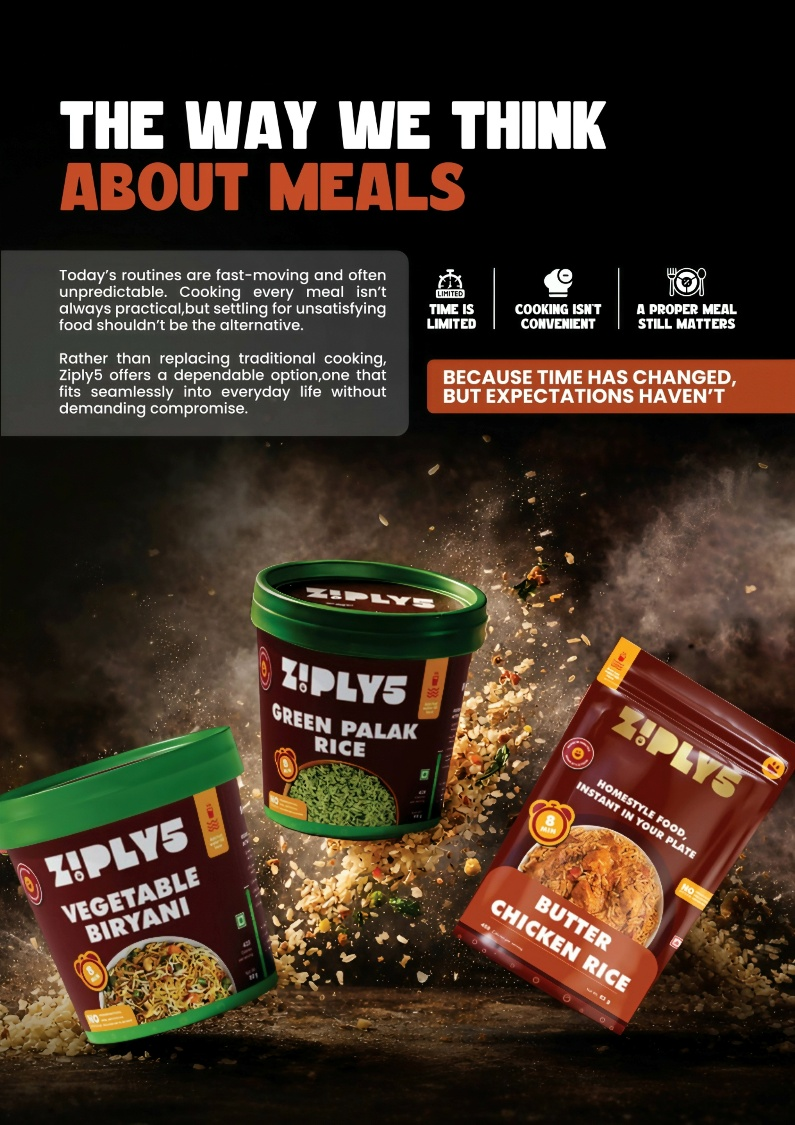
That founder-led authenticity often becomes a brand’s biggest advantage. Siddhardha Nallamothu’s stated inspiration from his mother’s kitchen reinforces that this is not a purely commercial exercise—it is a consumer problem being solved through personal conviction. Markets respond strongly when brands are built from lived truth rather than manufactured positioning.
As the ready-to-eat category becomes more competitive, only a few brands will command lasting authority. Those winners will likely share common traits: credibility, product consistency, emotional resonance, ingredient trust, and relevance to modern life. Ziply5 appears to be building across all five pillars.
The broader message is clear. Convenience food no longer has to mean compromise. Ready meals no longer need to feel artificial. Traditional Indian dishes no longer need to remain trapped in time-intensive formats.
Ziply5 is helping reshape consumer expectations by showing that fast can still be authentic, packaged can still be trustworthy, and modern can still feel like home.
That is more than a product success story. It is the emergence of a new benchmark for India’s ready-to-eat future.
To explore the brand’s growing range of meal solutions, visit https://www.ziply5.com/ and experience how tradition is being reimagined for today’s world.
Products are available on Ziply5 website and Amazon
If you object to the content of this press release, please notify us at pr.error.rectification@gmail.com. We will respond and rectify the situation within 24 hours.