.jpg)

Used Cars Have Gone from Budget Pick to Best Choice
For most of the last decade, the Indian used car market was framed as a fallback. It was the option buyers considered when a new car felt unaffordable, when the loan didn't come through, when waiting for a fresh model felt unrealistic. The Gears of Growth 2025 report by Cars24 and Team BHP records the moment that framing changed. The report states plainly that used cars are no longer a backup option. They have become a consistent, first-choice decision made throughout the year. The data behind this statement is striking, and the implications for India's automotive industry are larger than the line itself suggests. Cars24 x Team BHP Gears of Growth 2025 Report Year-round demand is the clearest signal of a mature market The single most telling number in the report is that every month of 2025 contributed between 6 percent and 10 percent of annual used car volumes. There were no festive surges. There were no off-season slumps. The Indian used car market simply hummed along at a steady pace through the calendar. As the report puts it, when a market stops depending on festivals, discounts, or external triggers, it signals maturity. This is a meaningful shift. The traditional Indian auto market has long been defined by sharp peaks around Diwali, Onam, Navratri, and year-end discount cycles. New car sales still ride this rhythm. The used car market, the Gears of Growth 2025 report suggests, has moved past it. Demand has decoupled from the calendar, and buying decisions are being made when they are needed, not when they are subsidised. Intentional buying, not opportunistic buying The report describes 2025 buyers as intentional and need-driven. They are not waiting for discount windows. They are buying when their life situation calls for it, when financing comes together, when the right model becomes available. This is the behaviour of a primary-market consumer, not a fallback one. Two factors are anchoring this shift. The first is affordability. The report observes that affordability continues to guide pre-owned car buying decisions, with consumers prioritising value retention and lower ownership costs as rising new car prices reshape the market. As new car prices climb, used cars are not just attractive, they are increasingly the more rational option for a value-conscious household. The second is trust. The report notes that consistent monthly engagement reflects growing trust in the used car ecosystem, as buyers gain confidence in certified inspections, transparent pricing, and seamless digital discovery. In other words, the same buyer who would have hesitated over a used car a few years ago now has the verification, pricing transparency and digital tools to feel confident in the decision. Premiumisation reinforces the first-choice story Used cars being the first choice does not mean buyers are choosing less. The Gears of Growth 2025 report finds that premium used car demand is led by models such as Creta, City, Nexon and Elite i20, indicating a strong appetite for feature-rich vehicles. Buyers are increasingly upgrading within a controlled budget, preferring newer-age vehicles with higher trims and better safety features. Premiumisation in the used car market, the report says, mirrors new car trends but remains firmly value-oriented. Feature depth, safety credentials and brand trust are emerging as key decision drivers in premium used car purchases. This is the language of a buyer who is choosing, not settling. The five-year price arc that backs this up The average selling price of a used car in India has moved from ₹4.49 lakh in 2021 to ₹5.66 lakh in 2024, before settling at ₹5.47 lakh in 2025. A modest GST-driven correction aside, the longer arc is one of steady upgrading. The Gears of Growth 2025 report attributes the ASP rise to four factors: a shift toward newer model years, rising demand for premium body types like SUVs and premium hatchbacks, feature and variant premiumisation, and supply constraints in newer vehicles. All four are first-choice buyer behaviours. None of them reflect a market of last resort. They reflect a market where buyers know exactly what they want and are paying for it. What this means for India's automotive industry The structural shift the Gears of Growth 2025 report describes has direct implications for how the Indian auto industry should think about its consumer. The used car buyer of 2025 is not a downgraded new car buyer. They are a different consumer making a different kind of decision. They are buying year-round, researching digitally, validating their choices through reviews and inspections, and increasingly paying for feature-rich, premium models. For carmakers, dealers, financiers and digital platforms, this means the used car market is no longer

For most of the last decade, the Indian used car market was framed as a fallback. It was the option buyers considered when a new car felt unaffordable, when the loan didn't come through, when waiting for a fresh model felt unrealistic. The Gears of Growth 2025 report by Cars24 and Team BHP records the moment that framing changed. The report states plainly that used cars are no longer a backup option. They have become a consistent, first-choice decision made throughout the year. The data behind this statement is striking, and the implications for India's automotive industry are larger than the line itself suggests.
|
|
Cars24 x Team BHP Gears of Growth 2025 Report
Year-round demand is the clearest signal of a mature market
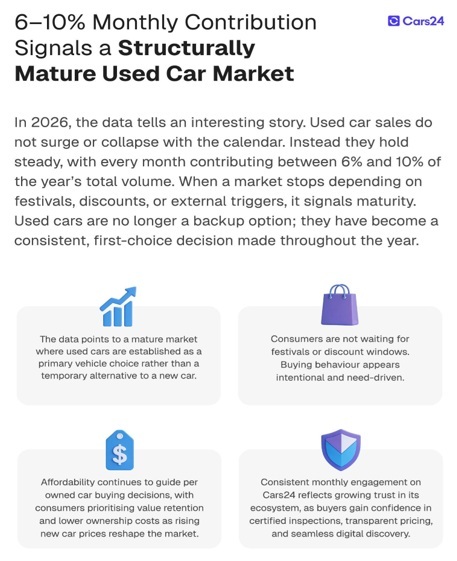
The single most telling number in the report is that every month of 2025 contributed between 6 percent and 10 percent of annual used car volumes. There were no festive surges. There were no off-season slumps. The Indian used car market simply hummed along at a steady pace through the calendar. As the report puts it, when a market stops depending on festivals, discounts, or external triggers, it signals maturity.
This is a meaningful shift. The traditional Indian auto market has long been defined by sharp peaks around Diwali, Onam, Navratri, and year-end discount cycles. New car sales still ride this rhythm. The used car market, the Gears of Growth 2025 report suggests, has moved past it. Demand has decoupled from the calendar, and buying decisions are being made when they are needed, not when they are subsidised.
Intentional buying, not opportunistic buying
The report describes 2025 buyers as intentional and need-driven. They are not waiting for discount windows. They are buying when their life situation calls for it, when financing comes together, when the right model becomes available. This is the behaviour of a primary-market consumer, not a fallback one.
Two factors are anchoring this shift. The first is affordability. The report observes that affordability continues to guide pre-owned car buying decisions, with consumers prioritising value retention and lower ownership costs as rising new car prices reshape the market. As new car prices climb, used cars are not just attractive, they are increasingly the more rational option for a value-conscious household.
The second is trust. The report notes that consistent monthly engagement reflects growing trust in the used car ecosystem, as buyers gain confidence in certified inspections, transparent pricing, and seamless digital discovery. In other words, the same buyer who would have hesitated over a used car a few years ago now has the verification, pricing transparency and digital tools to feel confident in the decision.
Premiumisation reinforces the first-choice story
Used cars being the first choice does not mean buyers are choosing less. The Gears of Growth 2025 report finds that premium used car demand is led by models such as Creta, City, Nexon and Elite i20, indicating a strong appetite for feature-rich vehicles. Buyers are increasingly upgrading within a controlled budget, preferring newer-age vehicles with higher trims and better safety features.
Premiumisation in the used car market, the report says, mirrors new car trends but remains firmly value-oriented. Feature depth, safety credentials and brand trust are emerging as key decision drivers in premium used car purchases. This is the language of a buyer who is choosing, not settling.
The five-year price arc that backs this up
The average selling price of a used car in India has moved from ₹4.49 lakh in 2021 to ₹5.66 lakh in 2024, before settling at ₹5.47 lakh in 2025. A modest GST-driven correction aside, the longer arc is one of steady upgrading. The Gears of Growth 2025 report attributes the ASP rise to four factors: a shift toward newer model years, rising demand for premium body types like SUVs and premium hatchbacks, feature and variant premiumisation, and supply constraints in newer vehicles.
All four are first-choice buyer behaviours. None of them reflect a market of last resort. They reflect a market where buyers know exactly what they want and are paying for it.
What this means for India's automotive industry
The structural shift the Gears of Growth 2025 report describes has direct implications for how the Indian auto industry should think about its consumer. The used car buyer of 2025 is not a downgraded new car buyer. They are a different consumer making a different kind of decision. They are buying year-round, researching digitally, validating their choices through reviews and inspections, and increasingly paying for feature-rich, premium models.
For carmakers, dealers, financiers and digital platforms, this means the used car market is no longer a derivative segment. It is a primary one, with its own demand patterns, its own decision drivers and its own consumer logic. The framing of pre-owned as backup, as compromise, as substitute, no longer matches the data.
As the Gears of Growth 2025 report concludes, pre-loved cars are no longer a second choice made on compromise. They are the smarter first move, balancing aspiration, value and reliability. In a market this large, that is a structural moment worth noticing.