



GoCredit Launches Free Loan App Checker to Verify If a Lending App Is Real, Fake or RBI Registered
GoCredit today launched a free loan app checker that tells any borrower in seconds whether the lending app on their phone is real, fake, or operated by an RBI-registered lender. The tool is live at gocredit.money/loan-app and answers a question millions of Indians currently settle by guesswork: is this loan app safe to use? GoCredit's free Loan App Checker names the RBI-regulated lender behind any lending app, from RBI's official directory of 1,024 digital lending apps A borrower types the app’s name. The free loan app safety checker searches it against the Reserve Bank of India’s public directory of Digital Lending Apps deployed by Regulated Entities - 1,024 apps as of 1 September 2026 — and against more than 9,200 RBI-registered entities. Where there is a match, the borrower sees the regulated entity behind the app, that entity’s grievance redressal officer, and the escalation route to the RBI Ombudsman. Where there is no match, the tool does not accuse: it hands the borrower a verification checklist and the official reporting channels. Why the “not found” answer matters most Google Play’s India policy requires personal loan apps to appear in the RBI’s DLA directory before they can be distributed. An app absent from that directory is therefore an app that should not be offering personal loans on the store at all. That distinction is the tool’s core design decision. Lists of banned loan apps circulate widely on Indian social media, but no official public list of banned apps exists: blocking orders issued under Section 69A of the Information Technology Act are confidential by law. In a written reply to Parliament in July 2026, the Ministry of Electronics and Information Technology stated that 87 illegal loan lending applications have been blocked to date; the names in those orders are not published. “Every viral ‘fake loan app list’ is somebody’s guess, and borrowers are making decisions about their money based on those guesses. The verifiable question isn’t which apps are banned — it’s which regulated entity is behind the app in front of you. RBI publishes that. We made it searchable,” Anupam Acharya, Co-founder and CEO, GoCredit. How to check if a loan app is RBI registered The company outlined the verification sequence any borrower can follow, with or without the tool: Search the app name in RBI’s DLA directory. Every legitimate digital lending app in India is reported to the RBI by the bank, NBFC or housing finance company that deploys it. Open the app’s About or Compliance screen. RBI rules require a lending app to name the regulated entity behind it. If no lender is named anywhere, treat that as the first red flag. Read the loan agreement or sanction letter. The legal lender is named at the top; it is frequently different from the app’s brand name. Never pay an advance “processing fee”. Registered lenders deduct charges from the disbursed amount; they do not collect fees by UPI before disbursal. Report what does not check out. Unauthorised lending apps can be reported to the RBI at sachet.rbi.org.in, or to the national cybercrime portal at cybercrime.gov.in and helpline 1930. What the tool deliberately does not claim The checker never describes an app as “RBI-approved”. The RBI compiles its DLA directory from information submitted by regulated entities on its CIMS portal and publishes it, in the regulator’s own words, without further validation. A listing is a disclosure by a regulated entity, not an endorsement by the RBI — and the tool’s language reflects that distinction on every verdict it returns. Built on regulatory architecture, not around it The tool is a consequence of the RBI’s Digital Lending Directions, under which regulated entities must report the apps they deploy. That reporting requirement is what makes an app-level public check possible at all. GoCredit renders the resulting directory in the form a borrower can act on: searchable by the name on their phone screen, with the grievance contact attached. Alongside the checker, GoCredit has published the complete list of RBI-registered loan apps in India, with a dedicated safety page for each app naming the regulated entity or entities that deploy it. The company operates an AI Loan Agent that matches borrowers to lenders through a single consent-based application, rather than repeated applications across multiple instant loan apps that each trigger a credit bureau inquiry. The safety checker extends the same premise to the step before borrowing: establishing who the lender actually is. Availability The loan app safety checker is free, requires no signup, and is available now at gocredit.money/loan-app. The underlying directory data is refreshed from the RBI’

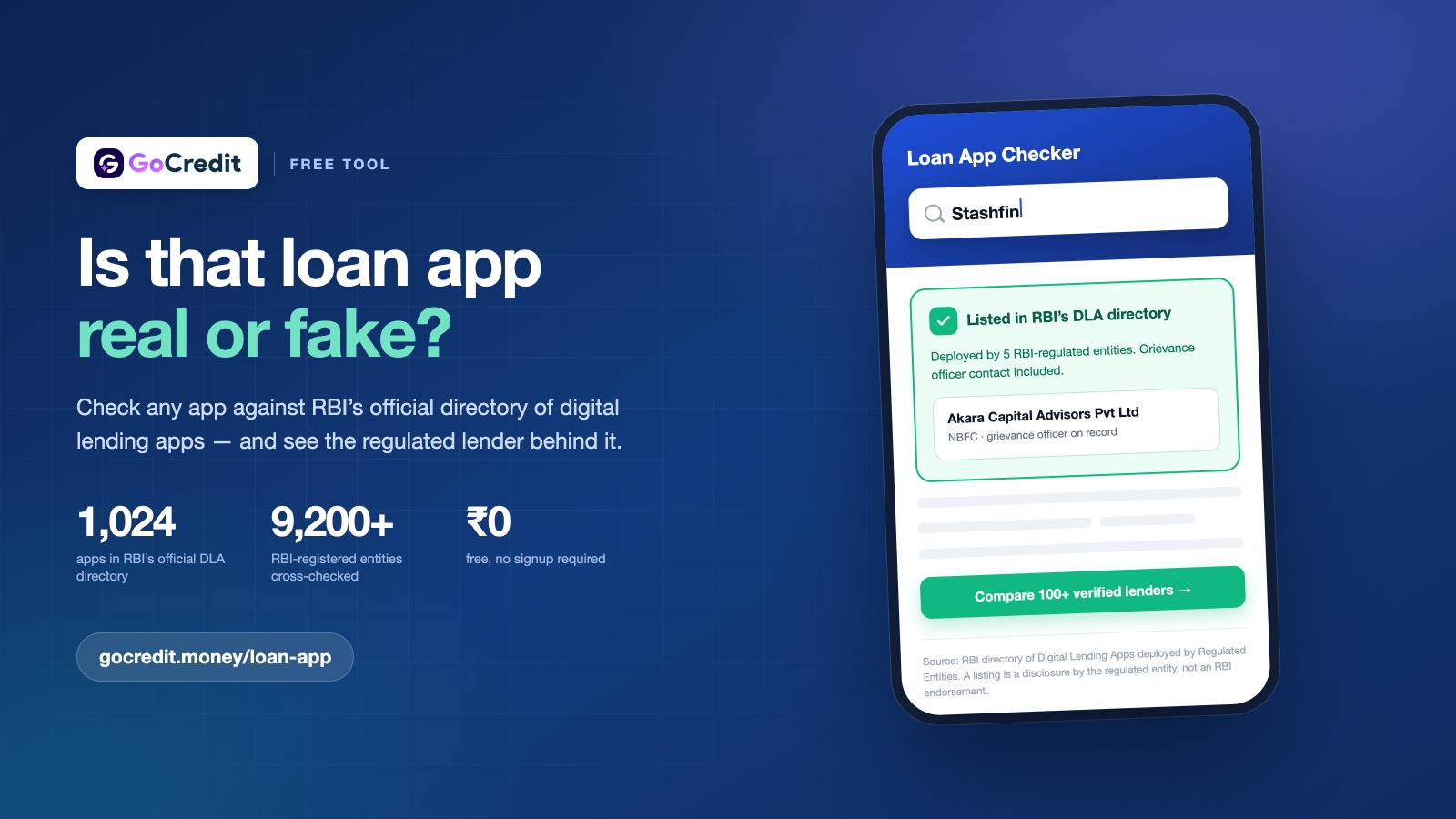
GoCredit today launched a free loan app checker that tells any borrower in seconds whether the lending app on their phone is real, fake, or operated by an RBI-registered lender. The tool is live at gocredit.money/loan-app and answers a question millions of Indians currently settle by guesswork: is this loan app safe to use?
|
|
GoCredit's free Loan App Checker names the RBI-regulated lender behind any lending app, from RBI's official directory of 1,024 digital lending apps
A borrower types the app’s name. The free loan app safety checker searches it against the Reserve Bank of India’s public directory of Digital Lending Apps deployed by Regulated Entities - 1,024 apps as of 1 September 2026 — and against more than 9,200 RBI-registered entities. Where there is a match, the borrower sees the regulated entity behind the app, that entity’s grievance redressal officer, and the escalation route to the RBI Ombudsman. Where there is no match, the tool does not accuse: it hands the borrower a verification checklist and the official reporting channels.
Why the “not found” answer matters most
Google Play’s India policy requires personal loan apps to appear in the RBI’s DLA directory before they can be distributed. An app absent from that directory is therefore an app that should not be offering personal loans on the store at all.
That distinction is the tool’s core design decision. Lists of banned loan apps circulate widely on Indian social media, but no official public list of banned apps exists: blocking orders issued under Section 69A of the Information Technology Act are confidential by law. In a written reply to Parliament in July 2026, the Ministry of Electronics and Information Technology stated that 87 illegal loan lending applications have been blocked to date; the names in those orders are not published.
“Every viral ‘fake loan app list’ is somebody’s guess, and borrowers are making decisions about their money based on those guesses. The verifiable question isn’t which apps are banned — it’s which regulated entity is behind the app in front of you. RBI publishes that. We made it searchable,” Anupam Acharya, Co-founder and CEO, GoCredit.
How to check if a loan app is RBI registered
The company outlined the verification sequence any borrower can follow, with or without the tool:
-
Search the app name in RBI’s DLA directory. Every legitimate digital lending app in India is reported to the RBI by the bank, NBFC or housing finance company that deploys it.
-
Open the app’s About or Compliance screen. RBI rules require a lending app to name the regulated entity behind it. If no lender is named anywhere, treat that as the first red flag.
-
Read the loan agreement or sanction letter. The legal lender is named at the top; it is frequently different from the app’s brand name.
-
Never pay an advance “processing fee”. Registered lenders deduct charges from the disbursed amount; they do not collect fees by UPI before disbursal.
-
Report what does not check out. Unauthorised lending apps can be reported to the RBI at sachet.rbi.org.in, or to the national cybercrime portal at cybercrime.gov.in and helpline 1930.
What the tool deliberately does not claim
The checker never describes an app as “RBI-approved”. The RBI compiles its DLA directory from information submitted by regulated entities on its CIMS portal and publishes it, in the regulator’s own words, without further validation. A listing is a disclosure by a regulated entity, not an endorsement by the RBI — and the tool’s language reflects that distinction on every verdict it returns.
Built on regulatory architecture, not around it
The tool is a consequence of the RBI’s Digital Lending Directions, under which regulated entities must report the apps they deploy. That reporting requirement is what makes an app-level public check possible at all. GoCredit renders the resulting directory in the form a borrower can act on: searchable by the name on their phone screen, with the grievance contact attached.
Alongside the checker, GoCredit has published the complete list of RBI-registered loan apps in India, with a dedicated safety page for each app naming the regulated entity or entities that deploy it.
The company operates an AI Loan Agent that matches borrowers to lenders through a single consent-based application, rather than repeated applications across multiple instant loan apps that each trigger a credit bureau inquiry. The safety checker extends the same premise to the step before borrowing: establishing who the lender actually is.
Availability
The loan app safety checker is free, requires no signup, and is available now at gocredit.money/loan-app. The underlying directory data is refreshed from the RBI’s published source.
About GoCredit
GoCredit is a personal loan platform operated by Vijayalakshmi Technology Infinity NKB Private Limited, offering an AI Loan Agent that matches borrowers with RBI-registered lending partners through a single consent-based application.
Website: gocredit.money
Sources Referenced
-
Reserve Bank of India - public directory of Digital Lending Apps deployed by Regulated Entities (rbi.org.in, Citizen’s Corner), accessed 1 September 2026.
-
Press Information Bureau - Release ID 2287195, Ministry of Electronics and Information Technology reply to the Rajya Sabha, 21 July 2026.
-
Google Play Developer Policy - personal loan app requirements for India.