






fischer Earthquake-proof Retrofitting Solutions - A New Hope for Millions of Existing Buildings in India
A research project carried out by the fischer Group of Companies in collaboration with Purdue University (USA) has shown that existing buildings can be made significantly more resistant to seismic forces through targeted retrofitting measures. In earthquake-prone regions, such solutions have the potential to improve structural safety and help protect lives. The severe earthquakes of recent days have once again tragically demonstrated how vulnerable people are in seismically active regions. The images of destroyed homes and the high number of casualties are deeply distressing – and raise a pressing question: how can such disasters be prevented in future, or at least their consequences mitigated? fischer earthquake-proof retrofitting solutions Part of the answer lies in the so-called building stock. While new buildings today are subject to strict seismic standards, millions of older structures worldwide were built long before modern earthquake-resistant design standards came into force. It is precisely in the places where people live and work that the necessary protection is often lacking. The real risk lies in the existing building stock Around 500,000 earthquakes are recorded worldwide every year (Source: US Geological Survey). Densely populated regions along the Pacific Ring of Fire, in the Mediterranean, in the Himalayan region and in Central America are particularly at risk. Furthermore, human activities such as geothermal energy extraction, fracking and the construction of large reservoirs can also trigger earthquakes. Demolishing and rebuilding all at-risk buildings is not a realistic option – it would be too expensive, too time-consuming and too resource-intensive. The crucial question is therefore: how can existing buildings be retrofitted so that they can withstand such events and help protect human lives? Research involving large-scale tests on full-scale structures To answer this question, the fischer Group of Companies, in collaboration with its partner university, Purdue University (USA), carried out a research project involving tests on full scale reinforced concrete structures. The project was led by Prof Akanshu Sharma, Associate Professor at Purdue University and former Endowed Professor at the Institute of Materials Science at the University of Stuttgart. The focus was on so-called beam column joints: the connection points between beams and columns. In the event of an earthquake, these can quickly become weak points in a structural system. “These beam-column joints in RC frame structures are subjected to particularly high stresses and significant force caused by horizontal loading during an earthquake.” explains Dr Margaritis Tonidis, a former PhD Candidate at Purdue University and leading Project Engineer of the project. If these joints fail, an entire building can collapse. Strong where it matters The solution tested addresses precisely these critical points: so-called haunch elements – in this case, steel diagonal braces – are integrated into the existing structural framework using injection mortar and threaded rods, thereby specifically reinforcing the joints on site. Dr Erik Johannes Stehle, Head of Development FiXperience at fischer emphasized “The tests have shown that the earth-quake resistance of existing buildings can be significantly increased if the critical points in the load-bearing structure are specifically identified and reinforced.” The key advantage is that the retrofitting can be carried out with relatively little intervention in the existing structure. Residents and users therefore need not fear extensive alterations. From experiment to practice Under seismic loading, a significantly improved performance was demonstrated, particularly at the joints. This successful scientific validation is now being translated into practical application for existing buildings. The results offer hope: they show that realistic and affordable ways exist to make older buildings more resilient – and thus significantly reduce the number of casualties in the event of an earthquake. Mr. Mayank Kalra, Managing Director, fischer India, says, “India has a vast building stock, including structures that were constructed before today’s seismic design standards were introduced. This research is particularly relevant for India, given the country’s vulnerability to earthquakes across several regions. Retrofitting existing buildings at critical structural points can offer a practical and more sustainable alternative to demolition and reconstruction, helping improve resilience while minimising disruption to occupants. At fischer, we see this research as an important step towards bringing scientifically validated retrofitting solutions closer to real world application in India, with the potential to strengthen e

A research project carried out by the fischer Group of Companies in collaboration with Purdue University (USA) has shown that existing buildings can be made significantly more resistant to seismic forces through targeted retrofitting measures. In earthquake-prone regions, such solutions have the potential to improve structural safety and help protect lives. The severe earthquakes of recent days have once again tragically demonstrated how vulnerable people are in seismically active regions. The images of destroyed homes and the high number of casualties are deeply distressing – and raise a pressing question: how can such disasters be prevented in future, or at least their consequences mitigated?
|
|
fischer earthquake-proof retrofitting solutions
Part of the answer lies in the so-called building stock. While new buildings today are subject to strict seismic standards, millions of older structures worldwide were built long before modern earthquake-resistant design standards came into force. It is precisely in the places where people live and work that the necessary protection is often lacking.
The real risk lies in the existing building stock
Around 500,000 earthquakes are recorded worldwide every year (Source: US Geological Survey). Densely populated regions along the Pacific Ring of Fire, in the Mediterranean, in the Himalayan region and in Central America are particularly at risk. Furthermore, human activities such as geothermal energy extraction, fracking and the construction of large reservoirs can also trigger earthquakes.
Demolishing and rebuilding all at-risk buildings is not a realistic option – it would be too expensive, too time-consuming and too resource-intensive. The crucial question is therefore: how can existing buildings be retrofitted so that they can withstand such events and help protect human lives?
Research involving large-scale tests on full-scale structures
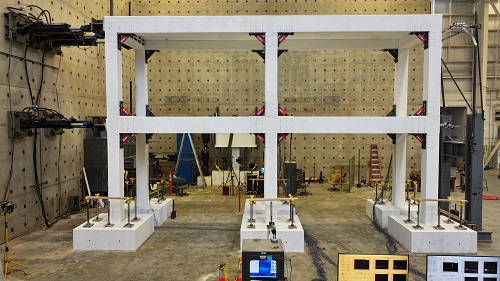
To answer this question, the fischer Group of Companies, in collaboration with its partner university, Purdue University (USA), carried out a research project involving tests on full scale reinforced concrete structures. The project was led by Prof Akanshu Sharma, Associate Professor at Purdue University and former Endowed Professor at the Institute of Materials Science at the University of Stuttgart. The focus was on so-called beam column joints: the connection points between beams and columns. In the event of an earthquake, these can quickly become weak points in a structural system.
“These beam-column joints in RC frame structures are subjected to particularly high stresses and significant force caused by horizontal loading during an earthquake.” explains Dr Margaritis Tonidis, a former PhD Candidate at Purdue University and leading Project Engineer of the project. If these joints fail, an entire building can collapse.
Strong where it matters
The solution tested addresses precisely these critical points: so-called haunch elements – in this case, steel diagonal braces – are integrated into the existing structural framework using injection mortar and threaded rods, thereby specifically reinforcing the joints on site. Dr Erik Johannes Stehle, Head of Development FiXperience at fischer emphasized “The tests have shown that the earth-quake resistance of existing buildings can be significantly increased if the critical points in the load-bearing structure are specifically identified and reinforced.” The key advantage is that the retrofitting can be carried out with relatively little intervention in the existing structure. Residents and users therefore need not fear extensive alterations.
From experiment to practice
Under seismic loading, a significantly improved performance was demonstrated, particularly at the joints. This successful scientific validation is now being translated into practical application for existing buildings. The results offer hope: they show that realistic and affordable ways exist to make older buildings more resilient – and thus significantly reduce the number of casualties in the event of an earthquake.
Mr. Mayank Kalra, Managing Director, fischer India, says, “India has a vast building stock, including structures that were constructed before today’s seismic design standards were introduced. This research is particularly relevant for India, given the country’s vulnerability to earthquakes across several regions. Retrofitting existing buildings at critical structural points can offer a practical and more sustainable alternative to demolition and reconstruction, helping improve resilience while minimising disruption to occupants. At fischer, we see this research as an important step towards bringing scientifically validated retrofitting solutions closer to real world application in India, with the potential to strengthen existing structures, protect lives and contribute to safer, more resilient communities.”
fischer Building Materials India Private Limited
Ward No. 76, Unit 101, First Level, No. 3 (Old 4 Prestige Sigma, Vittal Mallya Rd, Richmond Town, Bengaluru, Karnataka 560001


