



DrEducation Research Launches Comprehensive Report on Foreign University Campuses in India
DrEducation Research today released its first data-rich, comprehensive report to help students, parents, and counsellors understand the fast-growing landscape of foreign university campuses in India and choose with clarity. International University Campuses in India 2026 (Postgraduate Programmes): Classification based on DrEducation UniGrid™ The National Education Policy 2020, along with subsequent regulations from IFSCA in GIFT City and the UGC, permits foreign universities ranked in the world’s top 500 to open campuses in India. At least 20 such universities have signalled interest; this report takes a deep dive into the 13 already admitting students for the 2026–27 academic year: Aberdeen, Birkbeck, Bristol, Deakin, Illinois Tech, Liverpool, Queen’s Belfast, Southampton, UNSW, UWA, Victoria, Wollongong, and York. Based on an analysis of publicly available data from official university websites, the report finds that: These 13 universities operate across just 5 Indian cities. UK universities dominate the group (7 of 13), followed by Australia (5) and the US (1). Across 91 total programmes on offer for 2026–27, 53 are undergraduate and 38 are postgraduate. The average annual tuition fee is Rs 13.3L for undergraduate programmes and Rs 17.2L for postgraduate programmes. International university campuses offer an affordable pathway to earning a global degree in India. DrEducation Research compared average first-year undergraduate tuition fees at foreign universities in India against average first-year fees at a select set of Tier-1 private universities in India, and against fees for studying abroad at the same universities' home/parent campuses. The analysis found that studying at an international campus costs more than twice (115%) as much as a Tier-1 private university, but only about a third (36%) of the cost of studying abroad at the home/parent campus. The arrival of these foreign university campuses comes at a pivotal moment: tightening visa and immigration policies, combined with the rising cost of studying abroad due to currency depreciation, have dampened Indian students’ appetite for the traditional “big four” study destinations - the US, UK, Australia, and Canada. Why Choosing an International Campus Is Hard Right Now Dr. Rahul Choudaha, Managing Director of DrEducation Research and author of the report, explains, “For students and families, comparing and choosing among these international university campuses is a challenging task. There's no standard way to evaluate them yet, and the information that is available is often incomplete, inconsistent, or one-sided. Things students care about most - like campus life, faculty, and scholarships - aren't yet shared transparently or consistently this early on. And outcomes like job placements simply haven't been tested yet, since most of these campuses are brand new.” “As a result, prospective students and families are often left guessing - without a clear, objective way to judge which campus best fits their goals and budget. The DrEducation UniGrid™ closes that gap with a transparent, structured framework built specifically to help students, parents, and counsellors access a simple, visual way to see where each campus stands - without getting overwhelmed with scattered or inconsistent information - while also giving employers, universities, journalists, and policymakers a clear view of the scale, composition, and value of this emerging segment,” added Dr. Choudaha. How UniGrid™ Classifies Universities on Academic Ranking and Tuition Fee Using the proprietary framework of DrEducation UniGrid™, this report classifies and compares international university campuses operating in India. UniGrid™ plots universities on two axes - academic ranking and total tuition fee - and groups them into four easy-to-understand segments: MAXIMISER - better ranked, lower tuition fee PREMIER - better ranked, higher tuition fee ECONOMISER - lower ranked, lower tuition fee EXPLORER - lower ranked, higher tuition fee International University Campuses in India 2026 (Undergraduate Programmes): Classification based on DrEducation UniGrid™ Alongside an interactive, visual dashboard on the DrEducation website, a best-fit quiz helps students identify what they prioritize among various factors - such as tuition fee, location, field of study, programme duration, and university ranking - and see which campuses match. This brief quiz provides a personalised set of international campuses that may fit a student's needs. The same data and analysis reported in this research could help new foreign universities considering campuses in India make data-informed decisions on key aspects

DrEducation Research today released its first data-rich, comprehensive report to help students, parents, and counsellors understand the fast-growing landscape of foreign university campuses in India and choose with clarity.
|
|
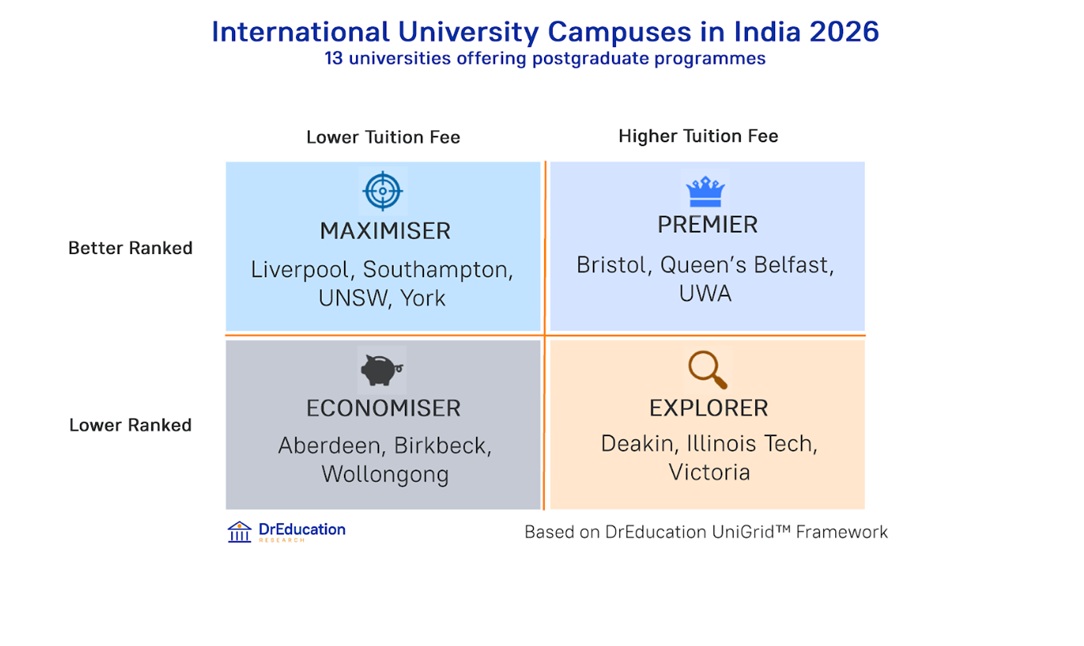
International University Campuses in India 2026 (Postgraduate Programmes): Classification based on DrEducation UniGrid™
The National Education Policy 2020, along with subsequent regulations from IFSCA in GIFT City and the UGC, permits foreign universities ranked in the world’s top 500 to open campuses in India. At least 20 such universities have signalled interest; this report takes a deep dive into the 13 already admitting students for the 2026–27 academic year: Aberdeen, Birkbeck, Bristol, Deakin, Illinois Tech, Liverpool, Queen’s Belfast, Southampton, UNSW, UWA, Victoria, Wollongong, and York. Based on an analysis of publicly available data from official university websites, the report finds that:
- These 13 universities operate across just 5 Indian cities. UK universities dominate the group (7 of 13), followed by Australia (5) and the US (1).
- Across 91 total programmes on offer for 2026–27, 53 are undergraduate and 38 are postgraduate.
- The average annual tuition fee is Rs 13.3L for undergraduate programmes and Rs 17.2L for postgraduate programmes.
International university campuses offer an affordable pathway to earning a global degree in India. DrEducation Research compared average first-year undergraduate tuition fees at foreign universities in India against average first-year fees at a select set of Tier-1 private universities in India, and against fees for studying abroad at the same universities' home/parent campuses. The analysis found that studying at an international campus costs more than twice (115%) as much as a Tier-1 private university, but only about a third (36%) of the cost of studying abroad at the home/parent campus.
The arrival of these foreign university campuses comes at a pivotal moment: tightening visa and immigration policies, combined with the rising cost of studying abroad due to currency depreciation, have dampened Indian students’ appetite for the traditional “big four” study destinations - the US, UK, Australia, and Canada.
Why Choosing an International Campus Is Hard Right Now
Dr. Rahul Choudaha, Managing Director of DrEducation Research and author of the report, explains, “For students and families, comparing and choosing among these international university campuses is a challenging task. There's no standard way to evaluate them yet, and the information that is available is often incomplete, inconsistent, or one-sided. Things students care about most - like campus life, faculty, and scholarships - aren't yet shared transparently or consistently this early on. And outcomes like job placements simply haven't been tested yet, since most of these campuses are brand new.”
“As a result, prospective students and families are often left guessing - without a clear, objective way to judge which campus best fits their goals and budget. The DrEducation UniGrid™ closes that gap with a transparent, structured framework built specifically to help students, parents, and counsellors access a simple, visual way to see where each campus stands - without getting overwhelmed with scattered or inconsistent information - while also giving employers, universities, journalists, and policymakers a clear view of the scale, composition, and value of this emerging segment,” added Dr. Choudaha.
How UniGrid™ Classifies Universities on Academic Ranking and Tuition Fee
Using the proprietary framework of DrEducation UniGrid™, this report classifies and compares international university campuses operating in India. UniGrid™ plots universities on two axes - academic ranking and total tuition fee - and groups them into four easy-to-understand segments:
-
MAXIMISER - better ranked, lower tuition fee
-
PREMIER - better ranked, higher tuition fee
-
ECONOMISER - lower ranked, lower tuition fee
-
EXPLORER - lower ranked, higher tuition fee
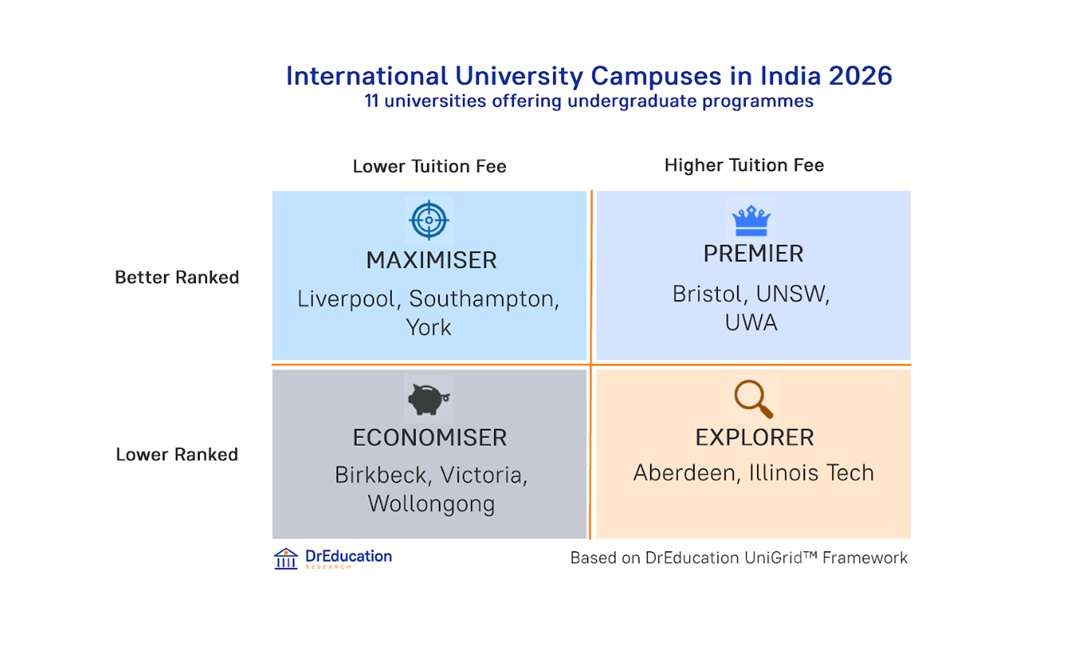 |
International University Campuses in India 2026 (Undergraduate Programmes): Classification based on DrEducation UniGrid™
Alongside an interactive, visual dashboard on the DrEducation website, a best-fit quiz helps students identify what they prioritize among various factors - such as tuition fee, location, field of study, programme duration, and university ranking - and see which campuses match. This brief quiz provides a personalised set of international campuses that may fit a student's needs.
The same data and analysis reported in this research could help new foreign universities considering campuses in India make data-informed decisions on key aspects of campus success, such as programme offerings, city selection, and tuition pricing.
About the Author
Dr. Rahul Choudaha is Managing Director of DrEducation Research and a globally recognised higher education expert. Before returning to India, he lived and worked in the US for 18 years, holding leadership roles at global organisations in the higher education sector. Dr. Choudaha holds a doctorate from the University of Denver. He has presented at nearly 200 conferences and has been quoted more than 300 times in leading media outlets, including BBC, Bloomberg, The Financial Times, The New York Times, The Wall Street Journal, The Times of India, The Economic Times, Business Standard, and Financial Express.