



Curated Retail: Why the Right Tenant Mix is Now More Important than Scale
For years, the success of a retail destination was largely measured by its size. Bigger malls, larger floor plates, and a higher number of stores were seen as indicators of stronger performance. However, that approach has evolved. Consumers today are not merely looking for places to shop; they are seeking environments where they can dine, unwind, socialise, and spend meaningful time. Curated retail spaces are redefining consumer experiences by blending shopping, dining, entertainment, and community-driven engagement under one ecosystem The leasing trends visible across NCR further reinforce this transition towards curated retail environments. According to C&W data, retail leasing in Delhi-NCR stood at nearly 0.6 million sq. ft. in Q1 2026, reflecting a strong 45% year-on-year growth despite a quarterly moderation. Gurugram continued to dominate leasing activity with a 54% share, followed by Delhi and Noida, underlining the growing strength of organised retail across key NCR micro-markets. Jatin Goel, Executive Director, Omaxe Group, said, "Retail in NCR has moved beyond just shopping; it’s about how people choose to spend their free time. When you look at the record 8.9 million sq. ft. of retail space absorbed across India recently, the standout metric isn't the volume; it’s that over 20% of leasing is now driven by food, beverage, and entertainment. Modern customers want an experience, which makes tenant curation one of the most critical parts of any retail real estate development today.” He further added, “We’re seeing the real-time impact of this shift across very different micro-markets. At World Street in Faridabad, for instance, we're seeing huge engagement simply because the residential growth there created a strong local demand for an organized, high-street experience. In Chandni Chowk, Omaxe Chowk is proving that even in historic markets, consumers want modern conveniences, which is why anchoring local and international brands with a massive food court works so well. And in Dwarka, we are developing The Omaxe State around the idea that sports, leisure, and retail should organically coexist in one ecosystem. Ultimately, retail real estate is no longer just about the square foot. It’s about curating a space that actually responds to what the modern consumer wants." Fashion emerged as the largest occupier category with a 32% share of overall leasing, recording a significant year-on-year jump, while entertainment and department stores also witnessed healthy absorption. At the same time, food and beverage leasing on main streets grew sharply compared to the previous year. Entertainment zones, family gaming centres, wellness concepts, and boutique fitness brands are also steadily expanding their presence across retail developments. Arjun Gehlot, Director, Ambience Group, said, “The role of malls has evolved significantly over the years. Consumers today expect retail destinations to offer experiences that extend beyond shopping, which is why tenant planning has become far more dynamic and data-driven. Categories such as dining, entertainment, wellness, and premium lifestyle retail are playing a much larger role in influencing dwell time and repeat visits. A successful mall today is not defined only by its size or brand count, but by how effectively the overall ecosystem works together.” Another prominent trend shaping NCR’s retail market is the rise of high street and community-centric retail formats. Consumers are preferring destinations that are integrated into their everyday routines while still offering aspirational lifestyle experiences. Pankaj Jain, Founder and CMD, SPJ Group, says, “Neighbourhood retail in Gurugram is witnessing strong momentum. But Old Gurgaon is where some of the most interesting retail energy is right now. The residential density, improving infrastructure, and evolving demographics here are creating sustained consumption demand. Consumers today prefer retail environments that are accessible, community-driven, and aligned with their everyday lifestyle needs. This is why curated retail formats are performing exceptionally well. The focus is no longer only on attracting large brands, but on creating the right mix of categories that can drive consistent engagement throughout the week. In many cases, well-planned neighbourhood retail is generating stronger and more stable footfall than larger standalone formats.” The growth of mixed-use developments where retail, residential, entertainment, and social infrastructure are coming together to create more self-sustained and community-oriented urban ecosystems is further encouraging the retail ecosystem. Uddhav Poddar, CMD, Bhumika Group, says, “The retail sector across NCR is gradually moving beyond the earlier ‘bigger is better’ mindset. Today, large retail spaces alone are not enough to attract consumers

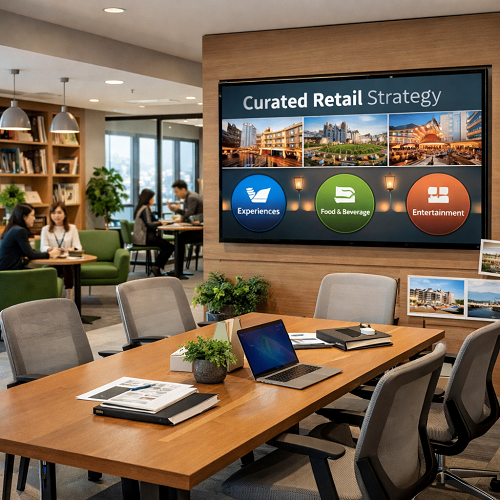
For years, the success of a retail destination was largely measured by its size. Bigger malls, larger floor plates, and a higher number of stores were seen as indicators of stronger performance. However, that approach has evolved. Consumers today are not merely looking for places to shop; they are seeking environments where they can dine, unwind, socialise, and spend meaningful time.
|
|
Curated retail spaces are redefining consumer experiences by blending shopping, dining, entertainment, and community-driven engagement under one ecosystem
The leasing trends visible across NCR further reinforce this transition towards curated retail environments. According to C&W data, retail leasing in Delhi-NCR stood at nearly 0.6 million sq. ft. in Q1 2026, reflecting a strong 45% year-on-year growth despite a quarterly moderation. Gurugram continued to dominate leasing activity with a 54% share, followed by Delhi and Noida, underlining the growing strength of organised retail across key NCR micro-markets.
Jatin Goel, Executive Director, Omaxe Group, said, "Retail in NCR has moved beyond just shopping; it’s about how people choose to spend their free time. When you look at the record 8.9 million sq. ft. of retail space absorbed across India recently, the standout metric isn't the volume; it’s that over 20% of leasing is now driven by food, beverage, and entertainment. Modern customers want an experience, which makes tenant curation one of the most critical parts of any retail real estate development today.”
He further added, “We’re seeing the real-time impact of this shift across very different micro-markets. At World Street in Faridabad, for instance, we're seeing huge engagement simply because the residential growth there created a strong local demand for an organized, high-street experience. In Chandni Chowk, Omaxe Chowk is proving that even in historic markets, consumers want modern conveniences, which is why anchoring local and international brands with a massive food court works so well. And in Dwarka, we are developing The Omaxe State around the idea that sports, leisure, and retail should organically coexist in one ecosystem. Ultimately, retail real estate is no longer just about the square foot. It’s about curating a space that actually responds to what the modern consumer wants."
Fashion emerged as the largest occupier category with a 32% share of overall leasing, recording a significant year-on-year jump, while entertainment and department stores also witnessed healthy absorption. At the same time, food and beverage leasing on main streets grew sharply compared to the previous year. Entertainment zones, family gaming centres, wellness concepts, and boutique fitness brands are also steadily expanding their presence across retail developments.
Arjun Gehlot, Director, Ambience Group, said, “The role of malls has evolved significantly over the years. Consumers today expect retail destinations to offer experiences that extend beyond shopping, which is why tenant planning has become far more dynamic and data-driven. Categories such as dining, entertainment, wellness, and premium lifestyle retail are playing a much larger role in influencing dwell time and repeat visits. A successful mall today is not defined only by its size or brand count, but by how effectively the overall ecosystem works together.”
Another prominent trend shaping NCR’s retail market is the rise of high street and community-centric retail formats. Consumers are preferring destinations that are integrated into their everyday routines while still offering aspirational lifestyle experiences.
Pankaj Jain, Founder and CMD, SPJ Group, says, “Neighbourhood retail in Gurugram is witnessing strong momentum. But Old Gurgaon is where some of the most interesting retail energy is right now. The residential density, improving infrastructure, and evolving demographics here are creating sustained consumption demand. Consumers today prefer retail environments that are accessible, community-driven, and aligned with their everyday lifestyle needs. This is why curated retail formats are performing exceptionally well. The focus is no longer only on attracting large brands, but on creating the right mix of categories that can drive consistent engagement throughout the week. In many cases, well-planned neighbourhood retail is generating stronger and more stable footfall than larger standalone formats.”
The growth of mixed-use developments where retail, residential, entertainment, and social infrastructure are coming together to create more self-sustained and community-oriented urban ecosystems is further encouraging the retail ecosystem.
Uddhav Poddar, CMD, Bhumika Group, says, “The retail sector across NCR is gradually moving beyond the earlier ‘bigger is better’ mindset. Today, large retail spaces alone are not enough to attract consumers or sustain long-term growth. Shoppers are increasingly looking for well-curated retail destinations where shopping, food, entertainment, and lifestyle experiences come together in a balanced manner. As a result, brands are also becoming more selective about the projects they associate with, preferring locations that match their customer profile and overall brand positioning. In markets like Gurugram and Faridabad, projects with the right tenant mix are seeing stronger consumer engagement, better occupancy levels, and more sustainable long-term value creation.”
Harpreet Singh Hora, Director, Reach Group, says, “In Gurugram, high street retail is increasingly becoming part of the city’s social infrastructure. Consumers are gravitating towards retail environments that feel active, walkable, and experience-led. As a result, the right tenant mix plays a far bigger role today than the overall scale of a development. A thoughtfully curated blend of F&B, boutique lifestyle brands, wellness, and entertainment creates stronger consumer stickiness and sustained footfall.”
In many ways, the most successful retail assets today are not simply leasing spaces; they are carefully curating environments where a balanced retail ecosystem matters far more than sheer retail density.
Ravinder Choudhary, Vice President, Vegas Mall, said, “Today’s consumers are no longer drawn to retail destinations purely by size or scale, they are driven by relevance, experience, and emotional connection. Malls that successfully curate the right tenant mix are emerging as stronger community ecosystems, not just shopping centres. A well-balanced combination of entertainment, food, fashion, lifestyle, family engagement, and everyday convenience significantly enhances dwell time, repeat footfall, and overall consumer loyalty. In the current retail landscape, thoughtful tenant curation has become one of the most critical drivers of sustainable growth and long-term differentiation.”
As retail consumption continues to become more experience-driven, the sector’s next phase of growth is likely to be defined less by the sheer size of developments and more by how intelligently they are curated.